

Architect & Builder
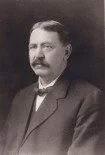
Henry Charles Trost
(1860 - 1933)
Architect
Henry Charles Trost was born in Toledo, Ohio, in 1860. He attended art school in Toledo and later began working as an architectural draftsman. In 1899, Trost moved from Chicago, Illinois to Tucson, Arizona. In 1903, Trost moved to El Paso, Texas and he partnered with Robert Rust, until Rust died in 1905. That year he formed the firm of Trost & Trost with his brother Gustavus Adolphus Trost, an architect. In 1908, Adolphus Gustavus Trost who was Gustavus' twin brother joined the firm as a structural engineer. Henry Trost was the chief designer.
Throughout his career Henry Trost demonstrated his ability to work in a variety of styles, including Art Deco; Prairie; and Mission Revival. The California Building at the 1893 World's Columbian Exposition, introduced the Mission Revival Style; and, the early-eighteenth-century Spanish colonial mission of San Xavier del Bac in Tucson, Arizona, established his interest in Mission Revival. Trost included the Mission Revival style in the Williams Residence - El Paso, TX, 1905; the Pueblo Revival, which included the Franciscan Hotel - Albuquerque, NM, 1923; demolished 1972; and, Bhutanese Dzong architecture, at the University of Texas - El Paso.
Many of the buildings designed by Trost & Trost display an influence from the Chicago School of Architecture. Henry Trost had lived in Chicago between 1888 and 1896. In 1889, Henry started the American Art Metal Work Company with Emil Henry Seeman, which lasted about a year. From 1892 to 1896, Trost served as vice-president of Chicago Ornamental Iron Company. The company is associated with metal ornament that formed the front railings of the boxes and balconies in the Lafayette Square Opera House in Washington, D.C.
Between 1903 and Henry Trost's death on September 19, 1933, the firm designed hundreds of buildings in the El Paso area and in other Southwestern cities, including Albuquerque, Phoenix, Tucson and San Angelo. He was greatly influenced by the works of Louis H. Sullivan and Frank Lloyd Wright. Trost was among the first to design buildings adapted to the desert region he called "Arid America"; and, adapting the Prairie School style for the rigors of high temperatures and hot sun by adding wide, overhanging eaves and balconies shading the windows.
Hundreds of buildings were commissioned throughout Texas, New Mexico, Colorado, Kansas, Arizona and Mexico. Some noteable buildings are: The first 13 buldings for New Mexico College of Agriculture and Mechanical Arts (New Mexico State University - Las Cruces, NM; Albuquerque High School - Albuquerque, NM; Val Verde Hotel - Socorro, NM; The Owls Club - Tucson, AZ; El Paso High School - El Paso, TX; University of Texas El Paso - El Paso, TX; Hotel El Capitan - Van Horn, TX; Buillon Plaza School - Miami, AZ; and, the following in Tularosa and Alamogordo, NM:
Tularosa
Red Brick School House
Alamogordo
Oliver Lee Residence
Alamogordo High School
New Mexico Institute for the Visually Handicapped
(Previously known as the New Mexico Blind Institute)
Administration Building Addition
Girls' and Boys’ Dormitories
Barn
Engine House
Garage
Gymnasium
Infirmary
Teacher Cottage
A listing of buildings by states of Arizona, Colorado, Kansas, New Mexico, Texas and the country of Mexico can be found at henrytrost.org

Robert Eugene McKee
(1889 - 1964)
Builder
Robert Eugene McKee, known to his family and close friends as Eugene, was born June 15, 1889 in Chicago, Illinois. When he was a small boy, his family moved to St. Louis, Missouri and he was educated at the Manual Training School of Washington University in St. Louis. McKee left St. Louis as a young man to live on his Uncle "Bud" Cleve's ranch in Elk, New Mexico. After a short stay at the ranch, McKee moved to El Paso, Texas, in 1910, to begin his career in the construction and engineering business.
By 1913, McKee started his successful contracting company, one of the largest individually-owned contracting firms in the United States, when it was incorporated in 1950. At that time, McKee had 42,000 employees on his payroll.Among the hundreds of McKee's accomplishments are:
Naval docks and Marine Hospital at the Naval Base, San Diego, California;
Hickam Field - Air Corps hangars, barracks and power plant, Pearl Harbor, Hawaii;
Los Alamos Atomic Energy Project, Los Alamos, New Mexico;
Facilities in the Panama Canal Zone;
Los Angeles International Airport, Los Angeles, California;
Conrad Hilton's chain of Hotels, Texas.
The Chapel at the United States Air Force Academy, Colorado Springs, Colorado
You may find more information about Robert Eugene McKee, The McKee Foundation,
books, CDs, DVDs and publications of historical interest for sale at: The Robert and Evelyn McKee Foundation